

A COLLECTION OF LIFE STORIES | Pat
and Mel Oakes
What store did you love to go to as a child? 5
Describe one of your most memorable birthdays. 7
What television programs did you watch in your
childhood? 9
What's the first major news story you can remember
living through as a child? 13
What were your least favorite school subjects? 15
What things are you proudest of in your life? 17
What was it like learning to drive? 25
What were memorable vacations from childhood? 29
What would you save if your house was on fire? 35
What's a small decision you made that ended up having a
big impact on your life? 39
What is one of your earliest childhood memories? 43
What are your favorite movies? 47
What's one of your go-to stories that always gets a good
response? 49
What qualities do you most value in your spouse or
partner? 51
What is one of your favorite memories of your father? 55
What's your favorite holiday, and why? 61
What stands out as one of your most meaningful
projects? 65
Who have been your closest friends throughout the years? . . . 71
What would you say is the best meal you ever had? 79
How would you describe your childhood bedroom? 85
How has the country changed during your lifetime? 89
What sports did you like most when you were young? 93
Who was your favorite school teacher? Why? 97
Describe any memorable school trips. 105
How would you describe the neighborhood where you
grew up? 107
What book has made a significant difference in your life? . . . 113
A Life-Changing Event 115
Travels with Don and Ann Kimber 119
What are some memories of your mother? 125
What store did you love to go to as a child?

I remember at Christmas time we went to a Firestone store — I think it was a place where you went to get tires. They also had
lots of toys. They always had a wonderful Santa Claus and we looked forward every year to going there to see Santa.
Mom would usually have all four of us at the store when she went grocery shopping. I am thinking that was not a good time for her—four of us born within a little over 5 years — that was a pretty good crowd to manage at the store! A particularly vivid memory of Tanners (a local grocery store—they did not have grocery chains back then) was standing close to the cart while Mom ground the coffee in a large coffee grinder—the aroma was amazing! Coffee was not sold then like it is now—and there certainly was not instant coffee. —Pat
My favorite stores were the two Five and Dime stores: S. H. Kress and Woolworth. Both were on Washington Street across the street from each other. They had wood floors. Items were inexpensive, so you got a lot for your money. Woolworth had an ice cream counter and I would order the cherry phosphate or strawberry soda. These stores were where we shopped for Christmas presents for family and for teachers and classmates. Evening in Paris perfume was a popular item for mother, aunts and teachers. Another store that fascinated us was J. C. Penney’s due to the overhead carrier system. This was known as a cash railway. William Stickney Lamson of Lowell, Massachusetts, patented this system in 1881. The clerk would put your payment into a metal carrier that looked something like a pencil sharpener housing. There were cords running along tracks that were overhead and descended to each counter. The clerk would stick the carrier on the track and away it would go to a second floor room where other clerks opened the carrier, made change, and sent it and your receipt back to the counter clerk. It was noisy, but there were always carriers moving along the tracks like mice. It was fun to watch.—Mel.
Describe one of your most memorable birthdays.

It was my 50th birthday party in 1986. It was an unusual day in May, as it had turned cold and was raining. It was Friday, May 9,
two days before my birthday. I walked into my first class and was returning an exam. It was one of the worst performances by a class in all of my teaching. So the students were not in a good mood, so when the physics staff behind the classroom came in with birthday cookies and cupcakes for the class, secretly provided by Pat, the mood was less joyful than some funerals I have attended. It was a disaster, plain and simple. Somehow I made it through the wake and returned to my office. Everyone in the plasma group was busy preparing their presentations for a plasma physics meeting. Again Pat, wishing to make this a special birthday, sent a birthday cake for the plasma group. No one wanted to take time away from their presentations to celebrate a birthday. There was no joy in Mudville. For the rest of the day, I focused on how good it would be to get to a warm
home with the family and put all of this behind me. When I walked through the door, there was a shout of Happy Birthday from 27 friends. Eleanor Towery, the minister’s wife, was waiting with a wheelchair for me. Guests included: Bob and Betty Little (sadly it was the last time we saw Bob, he died 10 days later), Dennis and Nodie Murphy, Garry and Judy Cole, Barada and Nandita Sarma, John and Eleanor Towery, Dave and Sara Ross, John Camden, Zorena Bolton and Harris and Irene St. Clair. Pat had made fajitas and a beautiful birthday cake. Everyone was in good spirits, which uplifted mine. Looking back, I would rate it as my best birthday party ever. —Mel.
What television programs did you watch in your childhood?

Oddly enough, we did not have a television in our home until after I went to college (1959). I think that my folks wanted us to
be reading rather than watching TV. What I remember as a small child is listening to the radio that was in the Florida room of our house on Campina Court in Coral Gables. It had a wooden case that was about 18 inches by 18 inches by 18 inches and had a record player with a lid on the top of it where we could play 78s.
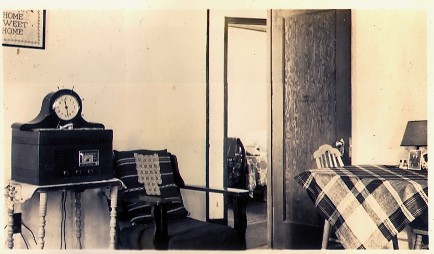
Early family radio.
We would listen to shows like “Our Miss Brooks,” Jack Benny, and “The Lone Ranger” as a family. When we moved to our 81st St. house in South Miami, Dad built a wall of shelves that incorporated a piano (we all took piano lessons at some point in our childhood) in the center and shelves for books and records and stereophonic speakers. We also listened to the classical music station WVCG. I don’t remember any popular music being played. I loved it when I went to babysit for kids whose folks had a TV. The frustrating thing was that there was no way to see the end of the show when the parents came home and took me home. Little did I know that I was longing for a DVR!—Pat
Our first experience with television was a set in an appliance store window on South Washington in the early 1950s. People
from all over Vicksburg would come and sit on the ground and watch the small screen. The nearest station was in New Orleans so the reception was terrible. It would depend on signals bouncing off of intermittent regions of high electron density in the ionosphere. Boxing was often the program. We would watch for many minutes waiting for the picture to emerge from the “snow.” It would last maybe a few minutes and then was gone. The family did not get a TV set until my senior year in high school, 1954, or maybe a bit later. The first station in Jackson signed on in January 1953. Like Pat, our entertainment growing up was radio. Every night we would gather around a Zenith console radio for our favorite shows, e.g. Jack Benny, Fibber McGee and Molly, The Great Gildersleeve, Eddie Cantor, Bob Hope, Lux Theater, Horace Heidt’s Talent Show, Mr. District Attorney, Baby Snooks, Our Miss Brooks, Edgar Bergen and Charlie McCarthy. At night we could pick up clear channel stations (50kW), KRLD in Dallas, WWL in New Orleans, WOAI in San Antonio, WSM in Nashville and XERF in Acuña, Mexico (100kW). Daytime reception was limited to WQBC in Vicksburg and WLBT in Jackson. The sun raised the electron density in the ionosphere and caused increased absorption of radio waves. It was almost impossible to listen during thunderstorms as the lightning created loud static. The kids listened to afternoon radio shows such as “ The Lone Ranger,” “Tom Mix,” “Hop Harrigan,” “Superman,” “Jack Armstrong,” “The All-American
Boy,” “Green Hornet,” “The Shadow,” “Big John and Sparky,” “Challenge of the Yukon,” “Sky King,” and “Captain Midnight.” The afternoon programs acted as a sitter for the kids while mother prepared dinner. I do remember an incident that shaped my thinking. The shows were often sponsored by breakfast cereals. To encourage purchases, they would have promotional features. One required you to send cereal box tops to get a decoder ring. Using the ring, you could decode a message broadcast at the end of the radio show. I decoded my first message. It said, “All men are created equal.” This was new to me and I asked my mother, if that were true, why were the Black people in the neighborhood not treated equally? I don’t remember her answer, but do remember hounding her for days for an answer. I should also confess that we kids sometimes listened with mother to her soap operas in early afternoon. Shows such as “Stella Dallas,” “Portia Faces Life,” “Lorenzo Jones and His Wife Belle,” “Mary Noble, Backstage Wife,” and “Ma Perkins” were her favorites. When television came, I was busy with college work so I didn’t watch much regular television. As a senior in high school, a girl friend and I would go down to the lobby of the Vicksburg Hotel to watch their TV set. I recall “Sid Caesar’s Show of Shows,” where I first saw Elvis Presley, “The Red Skelton Show”, “The Dick Van Dyke Show,” “All in the Family,” and “The Ed Sullivan Show.” PBS started in 1970 and has been our favorite channel since. —Mel
What's the first major news story you can remember living through as a child?

When I was in kindergarten, I remember so clearly asking my mother who was the President of the United States? She replied
in a scathing tone of voice that I can hear to this day: “HARRY TRUMAN!” I was quite taken aback. President Roosevelt had died some months before (I don’t remember that), but I do know that my parents at that time were Republicans and Truman was a Democrat—maybe that was the issue. I am not sure how they felt about FDR who was President during WWII—I wish I had asked them. Another story in the news that I remember was the outbreak of the Korean War—June 25, 1950. My 9th birthday was on the 28th of June, 1950. As a child, I remember feeling quite indignant that a war could possibly start on MY birthday! They probably had not talked about it in front of me on the 25th. News
did not travel as fast in those days.–Pat
What were your least favorite school subjects?

I liked almost every subject in school, but probably the one I liked least was arithmetic. A moment of math triumph came for
me in the 2nd grade when I clearly remember sitting at my desk writing on the lined paper all of the numbers from 1 to 100. I remember that my teacher Mrs. Adams was quite pleased with me, too. That felt good, as Mrs. Adams often became teary in class. Her only son had died in World War II and I don’t know if she ever got over it. It took me a long time to get my times tables memorized, which was in the 4th grade, I think. —Pat
What things are you proudest of in your life?

One of the things that I am most proud of in my life is the 20 family reunions I organized between 1972 and 2011—done
without the internet or cell phones! As I think about that, I still can’t believe that I did it. As I am sure I will mention in this memoir, I was very fortunate to come from a close-knit family that enjoyed seeing other family members. I am also the oldest of four children born within just a little over five years. As we grew up, married, and lived far away from each other, I kept trying to figure out a way for us to get together somehow with not just our siblings but also our aunts, uncles, and cousins. We had grown up spending at least a month in Wrentham, MA, during the summers and saw many of our cousins and aunts, uncles, and our grandparents while we were in the area. None of us had large homes or huge kitchens, so I was on the lookout for a way to make a reunion work.
In 1970, Mel and I became a part of the Danforth Foundation (a group interested in supporting religion and higher education) which was having a conference at the YMCA of the Rockies in Estes Park, CO. Eva and Peter Riley (the girls’ godparents) kept Beth and Sarah for us so that we could go. At the YMCA of the Rockies during the time we were there, I realized that this might be a great place for a real family reunion. Mel had pointed out that we needed to find places to go which had options for entertainment for everyone—not just sitting around and telling family stories—hiking, swimming, playing at the playground, sightseeing, etc. I remember asking questions of people who worked there about how it might work to bring our far-flung family together for a week. We realized that the YMCA of the Rockies had all of the things we liked.
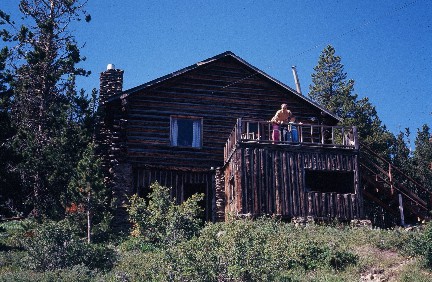
6/30/1972 First reunion—at the YMCA of the Rockies—Grampa with Sarah and Beth
We came home with lots of information and ideas and started contacting family members. There was a lot of interest, lots of letters and phone calls. In the meantime, we were expecting our third child who turned out to be Mardie. We headed out for Estes Park in late June, 1972—no fancy car seats for babies at that time; so Mardie rode in the front seat on my lap most of the time in a plastic Infant Seat. That scares the daylights out of me when I think of that! Beth and Sarah had the back seat to themselves.
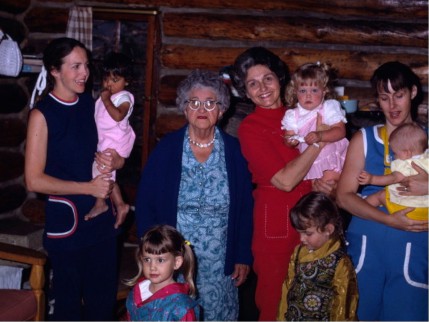
4 generations—YMCA of the Rockies—1972
Nancy, Kamala, Ruby Brown, Lois Winter, Shanti, Pat, Mardie with Sarah and Beth in front.
We all arrived on June 28th (my birthday) and departed on July 5, the day after my new niece Kamala Hatch (who was born and adopted in Nepal) celebrated her first birthday. There were 21 of us at that first reunion which included four generations. We decided that we would have another one in 1974. The third reunion was not until 1977 as folks were moving and buying houses, which complicated planning.
After the first two reunions we sort of got the hang of how it would work—so that everyone contributed in some way.
Families usually ate breakfast in their own cabins or spaces. Chore charts were made up for each day—figuring out menus, food shopping details, cooking, setting the table, clearing the table, doing the dishes, etc. Children who were 4 and up were helpers and involved, also. As the years passed, children were promoted to more advanced chores—and by the last reunion they were helping with the cooking. Aunt Florence was famous for her spaghetti nights. We roasted turkeys and stuffing. I often made black beans and yellow rice, a Guatemalan dish which was great for the vegetarians. I was big into baking and made a number of very large cakes which celebrated weddings, birthdays, and anniversaries.
Over the years, we visited sites in 9 different states (we were especially impressed with the beautiful parks in the state of Kentucky). Reunions were held in Colorado (2), North Carolina (4), Kentucky (5), Arkansas (1), Pennsylvania (1), New
Hampshire (2), Tennessee (1), West Virginia (2), and Minnesota
(2). There were 21 attendees at the first one, but our numbers had really grown by the last few.
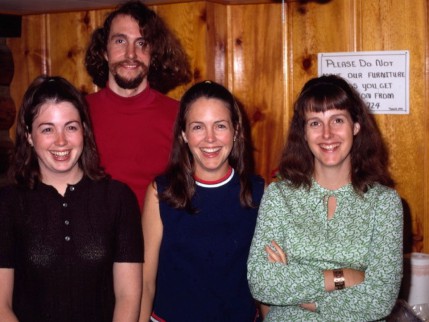
Sandy, Robert, Nancy, and Pat—YMCA of the Rockies—1972 At least by the third reunion we had developed the idea of a family talent show. There were enough kids and grown-ups playing musical instruments to put some ensembles together, which was really fun. We brought Beth’s viola and Sarah’s cello in the trunk of the car several years. Cousin Judi was especially talented at creating a poem about the reunion using the names of all of the attendees. A feature of the last few reunions was the “The Most Improved Relative” award, which included a crown made out of cardboard and aluminum foil. I’m not sure who came up with the idea, but the recipients were often teenagers who had not been the most cooperative in their younger years
but had now progressed to being terrific helpers!
An outgrowth of the family reunions came many years later during the Covid pandemic, which started in 2020. During that time, we did almost no traveling and I really missed seeing and talking to them. We had the idea of putting together a Zoom call (technology which had not been available earlier) every other Monday evening starting at seven, our time, eight on the East Coast and five on the West Coast. We have continued to enjoy them—having between 10 and 18 folks most Mondays. We’ve had a marvelous time sharing family stories, old slides and photos, helping each other out with names and dates, and learning about a lot of family connections. My mother’s brother Elton married my dad’s cousin Peg, so we were double cousins and enjoyed playing with them—and other cousins when we were in Wrentham in the summers.—Pat
The question is a little inappropriate for my answer. “Things” are not what I am most proud of, instead it is our three daughters. Also any pride should be shared with Pat and not in equal part, as she gets the lion’s share for raising three incredible women that continue to amaze us and fill us with joy and happiness. Early in our marriage, it was clear that our upbringings had certain similarities which included an important regard for honesty, sobriety, decorum, kindness toward others, self-reliance and discipline. This, I think, was the
reason we had little in the way of disagreement over decisions involving our children. Having three daughters was a far more challenging situation for me, with three brothers and one younger sister. Whereas Pat was one of three sisters with a single younger brother. Sports had been and remained a big part of my life; however, I can truthfully say that the small interest the girls showed in sports never elicited any regrets on my part. I found that their interest brought new things for me to learn and enjoy. Music, Girl Scouts, art, design, a wide variety of friends and their parents to name a few. All three girls were devoted to learning and did very well in school. They did not limit themselves to courses that might enhance their GPAs, but rather selected classes that might further their life goals and make for a well-educated person. Beth was especially interested in literature and music and became an accomplished violist. Sarah was more oriented toward the sciences and graduated in chemistry, and became an outstanding high school chemistry teacher. Mardie was especially interested in art and design, though she also enjoyed technical subjects. She became a successful architect, nonprofit developer, and entrepreneur.—Mel
What was it like learning to drive?

I learned to drive when I was in high school—probably my sophomore or junior year, 1957 or ’58. I didn’t take a driver’s
education class—I don’t think they had them then. I am pretty sure that my dad was the person who first put me in the driver’s seat. I do know that he insisted that if I wanted to get my license, I would have to know how to change a tire. I dutifully did learn how to do that. I vividly remember my mom taking me out to practice driving. She was a nervous wreck and shrieked several times. I was panicked and told her I was too jittery to drive with her. Dad was pretty busy at work, so my parents asked a friend of our family—Hap Collins—if he would take me out to drive. He was much more easy-going and it was easier for me to learn. The Miami area is very flat, so there were no problems with shifting on hills like Mel had in Vicksburg.
We had bought a rare (for us) new car in 1952—a Chevy station wagon with three-speed stick shift on the steering column. We were all so impressed with the new car smell. When Mom went to work while I was in high school, the folks bought a second car—a four-cylinder English Ford Prefect. Dad had a carpool with PanAm colleagues, so I am not sure what we did on the days Dad was driving the carpool. I used the family car to drive to and from work at Howard Johnson’s, where I worked for 4 summers after I graduated from high school. —Pat
I don’t remember any single event related to learning. There were no lessons available in school. Growing up on Dad’s junkyard we were permitted to drive large trucks and tractors around the yard and in the area that Dad used for farming. The trucks had very low gears, “double low” which meant they did not move very fast, which was also true for reverse gear. We were asked to back these vehicles out the long driveway that snaked through the junkyard. We were probably 13 or 14 at the time. You could obtain a driver’s license at 15, which we all did. The challenge on the driving test was the steep hills in Vicksburg. The officer administering the test would always have you come up the hill between Mulberry and Clay streets and stop at the traffic light. Now, since there were only clutch cars, you had to get off the brake, let out the clutch and press the gas pedal without rolling back into the car behind you. Very challenging.
Needless to say, the “hill-holder” and the automatic transmission were welcome innovations in Vicksburg. I passed the first time I tried, however, I recall it was quite stressful.—Mel
What were memorable vacations from childhood?

Every summer we went from Miami to Massachusetts to visit relatives. My dad was an only child and therefore the four of us
kids were my grandparents’ Winter only grandchildren.
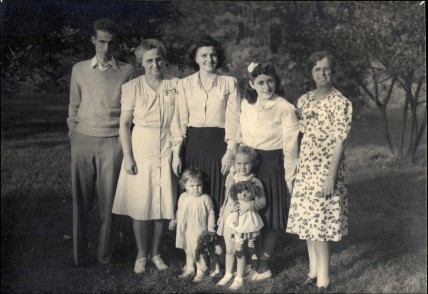
Sept. 1944. Robert Winter, Velma Winter, Lois Brown Winter, Doris Brown, Bertha White; front - Nancy and Pat Winter Date estimated.
The first time my folks took me to Wrentham, MA, was during the early days of WWII. I was less than a year old, it was a long way, and I remember my mother telling me in later years that the “disposable” diapers were pretty useless and that I tended to spit up a lot, which made it a pretty difficult trip. A lot of soldiers were traveling by bus, but they were pretty good about letting Mom have a seat. My dad worked for Pan American Airways and was exempt from the draft, but he did not feel right taking a seat from a soldier, so he stood more often than not. To get to Wrentham from Miami one had to go north on U.S. Highway
1—every stop light from Miami to Boston—no freeways. At that point I was too young to remember that “vacation,” but as the family grew, we would take Pan Am ferry flights from Miami to LaGuardia Airport (where the planes were worked on by mechanics) in NYC. We would get to Grand Central Station via a taxi to catch a train to Providence or Boston. I remember seeing the bustling traffic and the very tall buildings. At this time my mom was traveling solo with four kids. A vivid memory was the time we were at Grand Central when my baby sister Sandra’s stroller collapsed on her, causing her to cry loudly. A very kind porter came quickly and helped Mom get us to the train. As we got older and Dad had a longer vacation, we would drive both ways in our station wagon. Florida is a very long state going north and south and by the time we had gone a few hundred miles we would be pestering our dad about “how many more miles to Gramma’s house?” Seating arrangements in the station wagon were unchanging: Pat (behind Dad) and Nancy (behind Mom) in the second seat (which had us closer together because of the access to the back seat), and Robert and Sandra in the back seat. Bobby and Sandy would often quarrel and Nancy and I quickly learned to duck when Mom would grab the yardstick and swat at them. One year Dad rigged up a kind of bed made up of suitcases and bedrolls on the right so we could stretch out and snooze. I think it took 3 days and 2 nights to get to Wrentham. All 6 of us slept in one room at the motel where we stopped—two
of us kids on bedrolls on the floor. When we arrived we were greeted with such joy by our grandparents and Aunt Bertha (Gramma Winter’s sister who worked at the bank). We loved their home at 170 Winter Street. It was two stories, had a clawfoot bathtub in the upstairs bathroom; there was a small room that served as a small library complete with a scratchy horsehair-covered sofa. Grampa slept upstairs and Aunt Bertha’s bedroom was upstairs, too. Gramma had a small bedroom downstairs. It wasn’t until I was much older that I figured out why. They married in 1915, when Gramma was 29 and Grampa was 24, and had Dad, their only child, a little less than a year later. Having a child at the age of 29 was considered dangerous. Gramma had a very difficult delivery and was warned by her doctor that she could not safely have another child. There was no reliable birth control at that time, so the solution was to have separate bedrooms. That must have been so hard for them to decide. Aunt Bertha and Gramma and Grampa built a small downstairs bathroom and rearranged the furniture (particularly the pump organ) to make more room in a larger room on the first floor where we all could sleep. There was a large apple tree in the large side yard where Grampa created a swing. The grass was so much softer than the grass we had in Miami. There were climbing roses and raspberries (which we would pick in the mornings to put on our cereal) all along the stone wall, a vegetable garden, a flower garden with a gazing globe, and
cousins who lived across the street. It seemed like heaven to us. Wrentham was a small town and many of the folks who lived there were related to us in some way or another. There were lots of cousins to play with—Aunt Peg (my dad’s cousin) and my mom’s brother Uncle Bud’s kids, the adjacent George camp and Winter camp on Lake Archer. (A brother and a sister married a sister and a brother—George and Winter families—each set had five kids.) There was always someone to play with. One ritual we enjoyed was going with Grampa when he drove Aunt Bertha in the morning to the bank where she worked as a teller. There was a dip in a bridge over the railroad tracks which made our tummies feel funny and made us laugh—both going and coming. Aunt Bertha enjoyed walking home to Winter St. after work which she did most days. Grampa had developed Parkinson’s disease while he and Gramma were living in Michigan which had made life for him very difficult and forced their move back to Wrentham, but one thing he could do was walk to the railroad bridge up Winter St. and back. We loved to make that walk with him. Even now we are still close to our cousins. In 2021 (during the pandemic), no one was traveling, so Mel and I hit on the idea of doing a bi-weekly call on Zoom with my cousins and siblings—and it has been a wonderful way to share memories, photos, and family stories.
What would you save if your house was on fire?

On September 4, 2011, a huge fire started in Bastrop, a town about 34 miles from Austin. It burned for 55 days and destroyed
1600+ homes and killed two. It was a shocking event and we could smell the smoke in Austin. It had been a very dry summer and we began to think perhaps we should make some decisions about what to grab if we needed to leave our home quickly. We each made a list and compared notes. At the top of each list, we had the hard drives of our computers. At that point I decided on other things I would try to save. We put two large cardboard boxes in what had been Sarah’s bedroom and put things in the boxes. We kept things there for a while, but eventually put them back in their usual places.
Just recently, in January 2025, there were terrible wildfires in the Los Angeles area including Santa Monica, Pacific Palisades, Malibu, Topanga Canyon and other nearby communities. My
brother lives in LA not far from UCLA and after suffering from torrential rains caused by “atmospheric rivers” and the resulting growth of vegetation around homes and then a long drought leaving dead vegetation everywhere, the area was a tinderbox—plus the Santa Ana winds. The damage and loss were devastating and terrifying, which caused me to think again about what I would want to save. I have also just read a non-fiction book called FIRE WEATHER by John Vaillant, making me even more aware of having a plan in place. I know they are “just things,” but I am a very sentimental person.
At the top of my list were the 2 large high school graduation portraits of my grandmother Velma White and her sister, my great-aunt Bertha. I have a beautiful red glass lidded dish that my mother loved, so I would try to wrap it and make sure it would not break. My Grandmother Winter did some beautiful cross-stitch, framed creations which would come with us. We have two Auras, which are filled with special family pictures which would be easy to grab. One of my favorite books in the house is MANNERS, CULTURE AND DRESS, (copyright 1891) which was a gift to Gramma and Aunt Bertha for their mother had died early and Great-Aunt Hannah knew their father did not know all the things he needed to raise young women in that time. My mother made some lovely hooked rugs which would be in the boxes. I have an antique blackthorn cane that my dad
inherited from my great-great-grandfather John Ednie (d.1901) that would fit in the box. I have pictures of these things only on the computer in the photo library. —Pat
What's a small decision you made that ended up having a big impact on your life?

I attended a small rural high school, Redwood High School, in Warren County, Mississippi, near Vicksburg. The academic
offerings were very sparse; there were no language classes, the only science course was biology, algebra and geometry were the only math classes, and there was no band, choir, drama, or music classes. The school leadership in the county tried to consolidate the school with three other schools and offer more classes, however, the athletic opportunities afforded by having four schools trumped any such efforts. My English teacher was Mrs. Maude Franklin and she was excellent. She pushed her better students to consider college and worked to prepare them for the challenge. Because of my involvement in sports, I received a basketball scholarship to Hinds Junior College in
Raymond, MS. I was also on their baseball team. Arriving at college, I had to decide on a major. Since my ambition was to be a coach, I looked for a major in coaching or something that pointed in that direction. I found nothing. Now I had to select something. What to do? My thinking was, “Well, I always scored high in my math classes.” In fact, I made a 100 on every geometry test, which got a notice in the local newspaper. So I then looked for a major that would have required math classes, pre-engineering fit the bill, so that was what I selected. This decision was pivotal in my life. Related to this was one of those math classes. I chose an algebra class with Ms. Lurline Stewart. It was an excellent class and I had to work hard since there was much homework and I was spending a lot of time at basketball practice. After the second or third week, Ms. Stewart stopped me after class and inquired what my career plans were, I said, “I am going to be a coach.” Her response, “No, you’re not.” This surprised me. She said that with my math abilities I needed to think of some field that would require more advanced mathematics. She said when the time came she would contact Louisiana State University about a scholarship. She was correct on all counts. I met some students at Hinds majoring in physics. (I had never heard of this subject.) In fact, I recall my dad picking up a hitchhiker one day, when he got home, he told me the guy said his major was physics. Dad wanted to know what that was. I didn’t know.) Jim Mackey and Richard Crosby were
both physics majors and I started to hang around with them. They were a year ahead and taking physics. I soon became interested in their conversations and cynical sense of humor. They ended up at LSU, again due to Ms. Stewart. When I graduated, a scholarship for the non-resident tuition was secured by Ms. Stewart at LSU. A girl I was dating, Martha Gillespie, and another friend were going to LSU to major in music. All the arrows were pointed there so that is where I ended up, majoring in physics. The decision to select Pre-Engineering was quite critical to the rest of my life. Of course, these exercises always suggest many forks in the road along the way.—Mel
What is one of your earliest childhood memories?

My earliest memory occurred when I was four years old, in 1940. I am in a crowded room with many people talking quietly.
All the pant legs and skirts are black. I am standing next to my father, Fred Oakes. Suddenly, his rough, worn hands slide under my arms and I am lifted up and placed above an open coffin containing my grandmother, Mary Sophie Dose Oakes, aged 58. She was a tall woman raised in primitive conditions on the Yazoo River in Issaquena County. Her father, David Christian Dose, was from Kielerkamp, Germany. He jumped ship in New York Harbor in 1873 and came to Mississippi in 1879. Sophie had a twin brother, Jacob Christian, a sister, Carrie Mae, and a younger brother, Walter Samuel. Jacob and Carrie lived into the 1960s so I knew them. Carrie was my favorite; we called her Auntie. Walter served with the Red Diamond Division in France in WWI and was
gassed. He went AWOL in France after the war, is the story. Likely didn’t wish to return to the hard life in the Mississippi Delta. When he finally returned, the lung infections from the mustard gas caused many problems. He went to a Veteran’s hospital in Arizona, however Dad said he was unhappy and came back to Vicksburg where he died in 1925 at the age of 37. He is buried in the United States National Cemetery in Vicksburg. Sophie married Charles Franklin Oakes in 1900 in L’Argent, Mississippi, a town that no longer exists. Sophie and Charles had eight children with only five surviving to adulthood. The eldest was Frederick Franklin Oakes, my father. Jacob, Sophie’s twin brother, married Moyzelle Tindol ”Aunt Mosie”. She was previously married to Wilford Blake, who abandoned her after the birth of their son John. Wilford returned to Indiana and had no further contact with the family. Jacob and Moyzelle had six children. Their daughter, Vivian, stayed in close touch with our family. They attended the Seventh-day Adventist church that Mom and Eleanor attended. —Mel
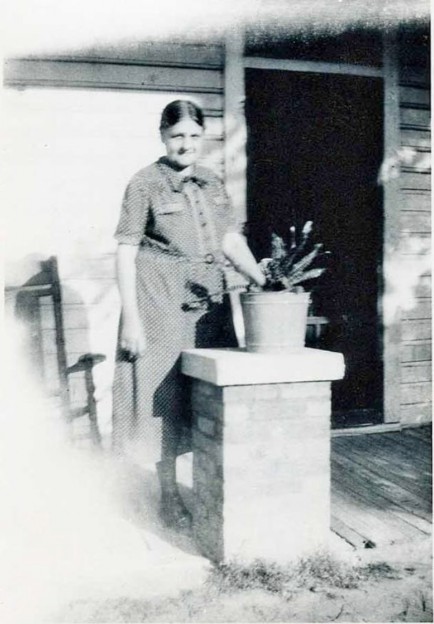
Sophie Dose Oakes
What are your favorite movies?

As a child we were able to see a lot of movies, unlike Pat. Mother would either drop us off on Friday after school or
Saturday morning at the Strand Theater. On weekends, the Strand showed primarily westerns accompanied by serials, cartoons, and newsreels. The westerns, despite being extremely repetitive in their storylines and location, were always enjoyed by the kids in the city of Vicksburg. Some of our favorite cowboys were Lash Larue, Hopalong Cassidy, Wild Bill Elliot, Roy Rogers, Don “Red” Berry, Charles Starrett (The Durango Kid), Bob Steele, Kit Carson, Johnny Mack Brown, Tex Ritter, Allan “Rocky” Lane and Buster Crabbe. Gene Autry was never popular with us as he was always singing and too interested in girls in the movies. All westerns paled with the arrival of Shane. Another genre was jungle movies, highlighted by the Tarzan movies and movies about his son, Bomba. For humor, Bud Abbott and Lou Costello, the Three Stooges, and Leo Gorcey and the Bowery Boys
were favorites.
Now, as an adult, my list would include: Hud, Twelve Angry Men, In the Heat of the Night, High Noon, Moonstruck, Shane, To Kill a Mockingbird, Mr. Roberts, Casablanca, Witness for the Prosecution, The Big Country, A Room with a View, The Best Exotic Marigold Hotel, The Bridge on the River Kwai, The African Queen, Suspicion, Jaws, Annie Hall, The Godfather, The Girl in the Cafe, A Man for All Seasons, Tootsie, From Here to Eternity, American Graffiti, Rear Window, The Full Monty, Brassed Off, O Brother, Where Art Thou?, and Best in Show.—Mel
What's one of your go-to stories that always gets a good response?

While a professor at the University of Texas, a colleague, Roger Bengtson, and I decided to host a conference on Radio
Frequency Heating of Plasmas in Austin. We would have attendees from around the world. One feature was a Texas barbecue which was very successful. Many participants stated they had never consumed so much meat in one sitting.
A component of the conference was invited speakers on special topics. I had the responsibility of inviting a well-known plasma physicist from Japan. I made the long distance call, which went something like this. The phone rang and a Japanese man answered. I said, “ Could I speak to Dr. Okada (name changed.)?” His response, “ Ohhh, many Okada in Japan.” I then said, “ I am looking for the physicist Okada.” He answered, “Ohhh, many
Okada physicists in Japan.” I then said, “ I am look for the plasma physicist, Okada.” His quick reply, “Speaking.”
Never assume.—Mel
What qualities do you most value in your spouse or partner?

My husband Mel and I celebrated our 62nd wedding anniversary on May 18, 2025. We have both had a lot of time to
look for and appreciate the qualities we each bring to our relationship. One of the best qualities Mel has is his constant search for knowledge—his curiosity goes on and on. He loves being presented with a problem (repairing our sometimes recalcitrant refrigerator, for instance). He doesn’t give up, keeps looking for the cause, does not get angry or throw up his hands in frustration. He keeps looking for the solution — and eventually he finds it. I tend to get impatient and crabby, but he stays calm and sticks with the issue.
Another one of his stellar qualities is his integrity. Mel is a retired professor of physics, teaching for more than 40 years at
the University of Texas at Austin. His dedication to his students inspired them to work even harder and many of them still stay in touch. For 62 years he has attended church with me every Sunday. He is not a believer (I am a cautious believer, was raised in the church and find comfort there) or a member of the church, but he has worked in many capacities at the church—joking at one point that he liked small churches and if he joined the church, it would get bigger. He is honest and faithful and the joy and love of my life.
Mel’s sense of humor is a wonderful part of the person he is. His humor helps me keep things in perspective—something I really need at times. He always has a good quip.
He is a wonderful father and has spent a great deal of time working with our 3 daughters on a variety of projects. I would often find Mel with one of the 3 girls on what came to be the homework couch in the dining room—helping them to understand—really understand—the finer points of algebra, for example. Our youngest daughter wanted a car in high school—and Mel spent more than a year helping her to rebuild a 1967 VW. He vowed that he would not work on it without her. She tested him for more than a month—realized that she was going to rebuild the VW with him—and what a bonding experience it was for them. And Mardie noted that she was a rare applicant at Rice University’s school of architecture —a pretty blond who
could explain to anyone how spark plugs worked.—Pat
When first meeting Pat at FSU, I was impressed with her quick-witted comments, interest in many subjects and upbeat personality. Soon I became aware of her deep love of family. She knew so many cousins and relatives and spoke of them with deep affection. Her relationship with her parents was genuinely loving and respectful. I never heard her utter a harsh word to them, surely rare among teenagers and young adults. She continued to show her love for them throughout their long lives. While sometimes impatient with herself, she was never impatient with them. As I watched her interaction with others, I soon appreciated the exceptional kindness that she has for everyone, and I mean everyone. She is always looking for opportunities to make life better for others. She is the first to volunteer when there is someone in need and is willing to sacrifice to support them. Finally, when I look back over her daily calendars, I am truly impressed with her capacity to accomplish so many things simultaneously. Her organizational skills are legendary, e.g., she organized twenty major multi-family reunions over a 40-year period without the internet. During this time she was raising a family, volunteering, teaching, active in her church, PTA, writing a column for a newspaper, maintaining an extensive social network of friends, etc. Of course, from a selfish standpoint, it has been her love and support for me that has
dominated all other considerations. Marrying me was a kindness that has sustained me and enabled any accomplishments I might claim. Marrying her was the best decision I made in my life.—Mel
What is one of your favorite memories of your father?

My dad, Robert Stewart Winter, Jr. (known as Bob) was a tall, very skinny, but healthy man. He was 6 feet tall and weighed 113
pounds for most of his adult life. I vividly remember the summer when I was 12 or 13. We had stopped along the New Jersey Turnpike at a rest stop on our way home to South Miami, FL, after visiting our grandparents and other relatives in Wrentham, Massachusetts. They had a big scale there and I begged my dad for a penny to weigh myself. To my horror, I weighed 115 pounds! That was a real shock—to weigh more than my dad. I do remember loving the bread, butter, and sugar sandwiches Gramma made for me—perhaps that had something to do with the weight gain! I also remember loving to get up early on weekends and sit out on the patio, by the pool with Dad, and read the newspaper. We would talk about some of the news stories
and he would explain them to me. Another special memory is the time when, during one of the many hurricanes that came through the Miami area, the eye of the storm went right over our house. Dad explained how it would work. The winds would be blowing very strongly from one direction, but when the eye passed over us, the wind would stop, and several minutes later the wind would pick up again, blowing from the other direction. I remember feeling very safe but transfixed as we stood in a protected corner on the patio by the pool when the winds suddenly stopped for a few minutes and then started up again from the other direction—just as he had said! —Pat
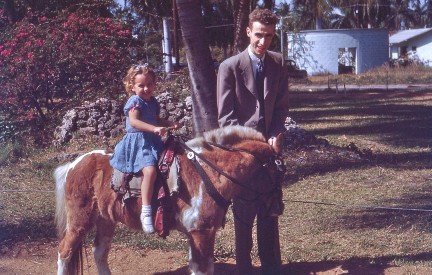
3/45 Pat on a pony—with her dad Bob Winter.
A couple of small stories that I recall. Dad sold used automobile parts from his “junkyard.” One day a woman came in and wanted to buy a used tire. When Dad would buy a wrecked car, often the tires were in good shape with many miles left on them. They were a popular alternative to an expensive new tire. There was always a pile of such tires on the yard, and customers would sort through them until they found something they liked. They would find Dad and ask the price. He would look at the tread left and the condition of the sidewall and give them a price. In this case, he told the woman that he wanted $10 for the tire. She acted shocked at the price and said it was way too much and that
$5 was more reasonable. Dad said that given the condition and tread, $10 was a fair price. I should note that we felt Dad always underpriced everything. The woman protested and maintained it was not a fair price. Dad said he disagreed. She continued to argue. Eventually, Dad lost patience and said, “I am not going to sell you this tire.” Naturally, she was surprised by this and had to think a bit before responding. Finally, she said, “Okay, I will give you $10.” He replied, “No, I said I was not going to sell you the tire.” She then said, “I will give you $11 for the tire.” Again Dad refused. She raised her offer, finally to $15, however, he would not sell it and she had to leave empty-handed. This is a story that I tell with mixed emotions. On the one hand, Dad’s customers were mostly poor African-Americans and Whites trying to keep their vehicles going to support their work or their
families. The woman was just trying to stretch her meager income as far as possible. Dad, on the other hand, knew his price was fair, likely even too low, and was unhappy that someone would suggest he was unfair and was taking advantage of a customer. There are no villains or heroes in this story, only real people struggling to survive.
Another incident that I recall. It was a Sunday afternoon and Dad and Mom, as was their habit, had gone for a drive to get some time by themselves. We never know how long they would be gone. We were in the house when there was a knock at the door. It was a customer who was interested in a two-wheel trailer Dad had for sale on the Hallberg lot next door. Floyd, Donald and I walked with him to look at the trailer. He asked what we wanted for the trailer. We had no idea what Dad would ask. The customer persisted so we told him $75. He said that was too high and could we take less. We decided that we shouldn’t make that decision. So we told him that he could wait until Dad returned and he would give him a price. The customer decided to wait. About an hour later Dad returned. He walked over and the customer asked Dad what he wanted for the trailer. Dad said, “$150”. The customer bought it, he made no reference to our much lower price from earlier. My assessment, he knew that Dad knew the true value of the trailer and he likely did not and he certainly recognized that we did not know the true worth of it. —Mel
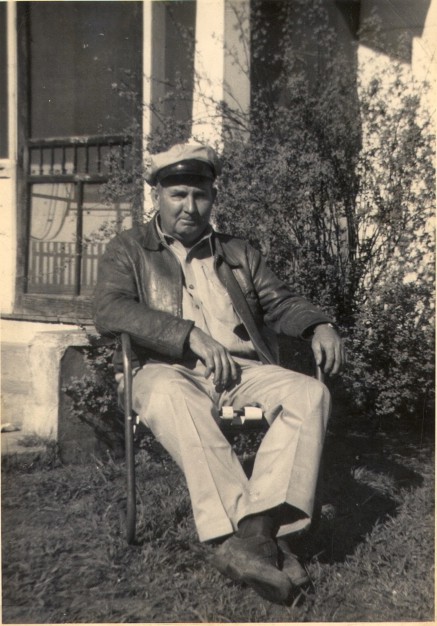
Fred Oakes in chair at Kings’ home, 1945
What's your favorite holiday, and why?

Christmas was unquestionably my favorite holiday and I am sure my siblings felt the same. My parents made a big deal about
the holiday. It usually started with a trip up in the hills to cut a Christmas tree. I can remember the trips on cold days to find just the right tree. The trees usually came from property owned by friends and neighbors. We had a red metal tree stand that we used for as long as I can remember. My mother had a box of decorations that she brought out every year. These included lights, bulbs, garland and the old style lead icicles. The tree was topped by a star. Over the following weeks people would start to put presents under the tree for family members. The children would be given some money and taken to the five-and-dime stores in Vicksburg to shop for presents. The two stores were Woolworth’s and S.H. Kress. S.H. Kress operated from 1896 to 2001. Each member of the family could request what they would like for Christmas. Mom and Dad were pretty faithful in filling
our requests. Since we had an inactive chimney, Santa was forced to enter through the front door. It was a ritual to make sure it was unlocked before we went to bed and to leave cookies near the door. Memorable gifts were cowboy outfits, always clothing, BB guns, books, paper and toy dolls for Eleanor and games. One year Mother got us all roller skates, despite there being no suitable surface on which we could skate. We chose the highway, which was soon vetoed. Uncle JC and Aunt Aileen were always there on Christmas Day and came loaded with gifts for everyone. Aileen was fun to be around on holidays. Uncle JC was quite taciturn but enjoyed being with the large group. I remember one year we discovered where our presents were hidden and when Mom and Dad would go into town, we would take them down from the high shelf in the bathroom closet and play with them. Mother always cooked a large turkey and made excellent stuffing. There were pies, ambrosia, vegetables and rolls. After dinner, there would be family stories told; other cousins and friends might come by. I remember a number of times we would all load up in the car and go over to Uncle Rufus’ and Aunt Leila’s place in the park. They had a big family and the cousins enjoyed visiting one another.—Mel
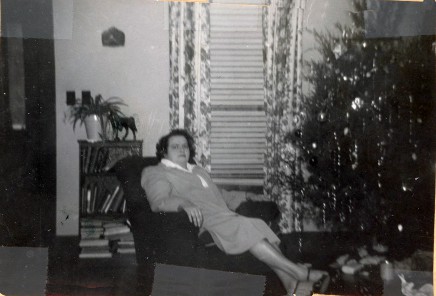
Margie Louise Hartley Oakes, Christmas 1950
What stands out as one of your most meaningful projects?

During my daughter Mardie’s senior year of high school, she approached me one day and announced, “I will need a car when I
go off to college.” I pointed out that her sisters, Beth and Sarah, had gone to college and did not have cars. Mardie protested that her situation was different. She was going to be an architect and would be assigned projects that would require materials from lumber yards, Home Depot, used material shops, etc. This made sense to me and I was convinced. I made her an offer. It just so happens that my colleague, John Durbin, owned a 1967 VW bug. He and Jane had purchased it in Europe in 1966, the same year Pat and I picked up our 1966 VW in Paris. Our car was a late ’66 and theirs was an early ‘67. We decided that given our itineraries, the two cars likely passed each other sometime that summer. John’s sons had driven the car and forgot to check the
oil, resulting in a thrown connecting rod. It had not penetrated the engine wall, however. John wanted $125 for it, likely a special price for me. My proposal to Mardie: I would buy her the car and we would rebuild the engine and restore the rest of the car. One caveat however, “I would never work on the car alone. If she were not helping, there would be no progress.” She agreed and we pulled the car home with our family car. The car sat in the driveway for over a month as Mardie tested my resolve. One day she came in and said, “Dad, let’s do it.” And she meant it. We quickly pulled the engine and bought an engine rack which made rebuilding easier. We had to pull the oil pan, the head, the crankshaft and remove the pistons. We decided to soup up the engine to a 1600 cc from the original 1500. We purchased an engine rebuild kit which had all gaskets, seals, rings, etc. We used the very popular, “How to Keep Your Volkswagen Alive, A Manual of Step by Step Procedures for the Compleat Idiot.” by John Muir. Muir was an artist in New Mexico who ended up repairing other artists’ VWs and soon it became a full-time job and he wrote an excellent guide that most VW owners used for tune-ups, repairs and rebuilds.
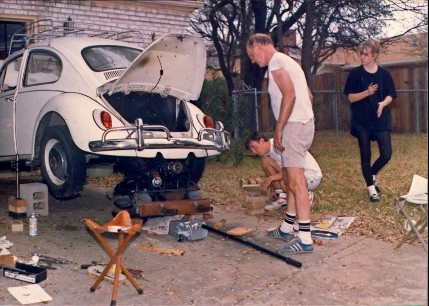
6/1989 Mel, Mardie, and Will Jenkins removing the motor from the VW, 1989
Soon after we started the rebuild, Mardie’s classmates would see us working in the driveway and drop by. Often the male classmates were suspicious of Mardie’s role in the project and would quiz her on some aspect of the work. She always nailed the answers, much to their surprise. We replaced the clutch plate, pressure plate, brake shoes and wheel and master cylinder seals. We put new upholstery, floor mats, and removed all rust from the engine and body. In fact, we even cleaned the exhaust and the large fan and painted them with heat-resistant enamel. I remember we visited Kenny Hill’s VW shop to get some advice on setting the .009 distributor. He reached back into the fan
housing and when he brought his hand back, he said, “That has never happened before.” We said, “What do you mean?” His reply, “No exhaust carbon soot on my finger!”
Finally, the big day came, we were putting the engine back into the car. One of Mardie’s male friends came over to help. Pat helped also. It was quite an operation but went very smoothly. The engine started up after only a few turns. It took a bit of adjusting of the carburetor and distributor to get it running well. It was a white car and was a beauty.
Fall came and Mardie went off to Rice University in Houston. She maintains that her application interview was so successful because the interviewer was interested in cars and that they got on the subject of the restoration. Needless to say, a pretty blond girl talking about car repair would be irresistible.
I wish this story had a happy ending, however, during her first semester at Rice, the car was stolen from the Rice parking lot. There were many far newer and more valuable cars nearby, however, they went for the VW. Our friend John Murphy had contacts with the Houston Police Department. He was told it would have either been taken immediately to a “Chop Shop” and disassembled for parts or driven to Mexico. Pat came home early the day I found out it was stolen. I was sitting in my chair listening to Jesus Christ Superstar. I told her the car was stolen
and I was trying to get some perspective. Mardie and I console ourselves by remembering they did not steal all the memories and satisfaction we had from the project.—Mel
Who have been your closest friends throughout the years?

Just thinking about this story topic has stirred up lots and lots of memories—making me realize how lucky I have been to have
so many good friends in my lifetime. If I go back to my childhood, I remember Dawn Davis who was the daughter of Rev. Dr. David Davis who was the minister of our church, Plymouth Congregational Church in Coconut Grove, FL. In fact, Dr. Davis was the minister who presided over our wedding on May 18, 1963. As kids, Dawn and I played and had a good time at church and Sunday school and have remained friends to this day. Another friend from church and elementary school was Nancy Cook. I vividly remember spending the night at Nancy’s home and her mom, Katherine Cook, would play the violin for us as we drifted off to sleep. Another friend, Nancy Martin, became a good friend of Dawn’s and mine. We were going through a phase of
playing silly games with our names. Dawn’s name didn’t work as well as her initials were D and D, but I became Wat Pinter and Nancy Martin became Marcy Nanton. We still call Nancy “Marce”, but sadly she is having serious memory issues and lives in a nursing home now and no longer remembers much. Evelyn Melli was a good friend in the neighborhood and at school (Merrick Demonstration School). Her dad had a shoe repair shop just about two blocks away from us on Campina Court, and she and her parents lived above the shop. Remarkably, Evelyn now lives across the street from where our family lived until the early 1950s. Our old house, which we moved into when my sister Nancy was born, is still there and she keeps me apprised of changes. Sophia Spiroff and her brother Richard (called Dickie at that point) were our neighbors on Campina Court, and we played together all the time— I am still in touch with Sophia and remember her parents Pauline and Peter (from Greece and Bulgaria). Mr. Spiroff called our sister Sandy, “Puny”, for years, as she was born very early and was quite tiny for a long time. Dawn and Marce were good friends during high school. When I went off to college, there were new friends — Jane Ream (still in touch), Sue Gunderson (later Sue Berkley, as she married Mel’s dear friend, Richard “Dick” Berkley.)
Once we arrived in Austin in 1964, we became dear friends of Peter and Eva Riley—Peter (from Canada) having been a grad
student in physics at FSU with Mel—and Eva grew up in Miami. We are still dear friends.
We have also been blessed with wonderful friends from our church—Dave and Sara Ross, Nodie and Dennis Murphy (we miss Dennis so, as he died several years ago very suddenly), Pam Tucker, the Towerys, Rambie Briggs and Fran Briggs (she died this past year).
We have also been blessed with wonderful friends and neighbors on Briargrove Drive—our street, where we have lived since 1967, the year Beth was born. When our daughter Mardie was born in 1972, our next-door neighbors were Donna and Charles Jobe. They had a son Bryan, a few months older than Mardie, when they moved in and later had a son Reagan. Mardie and Bryan became fast friends—there was a track through our front lawns leading to each other’s houses. Donna recently died and Charles died some years ago, but we are still in touch with Bryan.
Another longtime group of friends in Austin started out as a group of 4 couples—Carole and Bruce Buckman, Mel and Pat Oakes, John and Sue Murphy, and Roy and Ruthann Rushing. Our children attended the same school and over time we became fast friends. As the kids grew and we went back to work, we no longer met at Zilker Park for Friday picnic lunches with children. We missed seeing each other and decided to organize a supper club.
We would get together once a month on a Sunday evening and rotate hosting with the guests bringing side dishes and the hosts providing the main course. We have lost Bruce Buckman and Roy Rushing and miss them terribly. Kay Hopper, also a neighborhood friend, was also widowed, so she came with Carole Buckman after Bruce died. Since Roy died and Ruthann Rushing was living out at Lakeway, our gatherings became less frequent. so now we tend to meet at Central Market South for lunch every so often.—Pat.
Growing up in Mississippi in a small community, I had many friends. One of the earliest was Barbara McDuff who lived only about 75 yards away with her brother, Bill and Grandmother Roberts. Barbara and Bill’s mother died when Barbara was born and their dad turned the kids over to his mother-in-law to raise. We spent many hours playing Monopoly, Parcheesi, and cards in their large two-story house. Luckily when Pat and I moved to Austin, Barbara and her husband, Pete Guttery, were living here. We renewed our friendship which lasted until Pete and Barbara died. School friends were Wilson Brent, who became a Methodist minister and was part of the Civil Rights movement in Mississippi, Earl Martin, who became director of physical facilities at LeTournea College in Texas, Pat and I shared a number of weekends with Earl and wife, Dimple, before he passed away with lung cancer, finally Johnny Griffin and his wife
Jane Keen were friends since grammar school. They remained at Redwood and we visit and phone often. Earl, Johnny and I played three sports in high school.
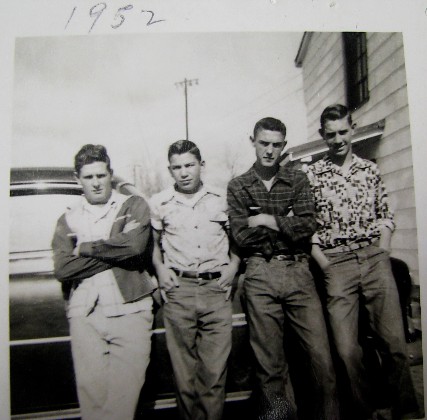
Will Breland, Earl Martin, Johnny Griffin and Mel Oakes When I went to Hinds, Tom Hudson and Jimmy Mackey became friends through our interest in physics and math. Both later taught at schools in Texas. After moving to LSU for my junior and senior years, my roommate, Jonas Holdeman, became a
lifelong friend. He worked in Tennessee and we still stay in touch.
In graduate school at FSU, I met Richard Berkley. A fellow physics student from Marshalltown, Iowa. Richard was brilliant and a great friend. I learned much from him. I wrote an article on our family website about him and his career. He had an important influence on my understanding of the race issues prevalent during that time. Richard’s wife, Sue, became a great friend to this day. Richard died far too early of colon cancer.
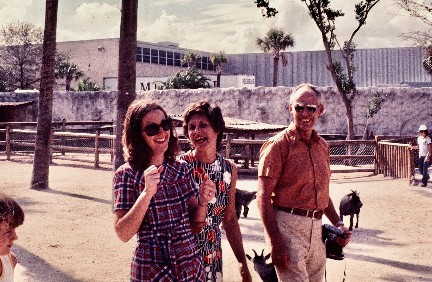
Pat, Sue and Dick Berkley, Busch Gardens
At University of Texas I brought Roger Bengtson into the department and he and his wife Billie became lifelong friends until their untimely passings. Roger and I shared many projects
professionally and privately.
Pat, being a Congregationalist, meant we attended the Congregational Church of Austin. There we met Dennis and Nodie Murphy and Dave and Sara Ross. Both couples became great friends. Dave was also in plasma physics at UT.—Mel
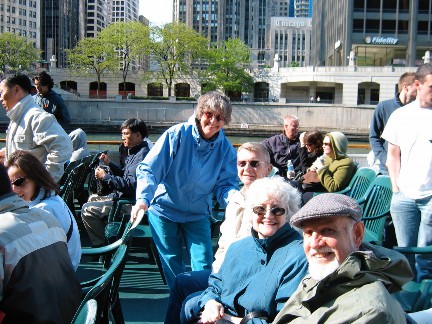
Pat, Dennis, Nodie and Mel
What would you say is the best meal you ever had?

Pat and I were visiting England in 1994. On these trips we would travel with Don and Ann Kimber. They would drive their
car and we would provide petrol. We first met Don in the 1960s at Florida State University; he was a graduate student in geography. He was a Congregationalist and attended a student group that Pat attended and I later joined at the behest of my fellow physics graduate student Dick Berkley. When Don returned to England he met Ann and they married, moved to Bristol and had two children, Philip and Paul. The boys were grown when we later started to travel together. On one trip we were visiting Weobley, a picturesque village in Herefordshire, England, famous for its abundance of historic, black-and-white timber-framed buildings. We were staying at Mellington House which had wattle and daub construction, a garden, and an orchard. Pat and I stayed in the Coach House, which had a double loft-style bedroom on the first floor, and Don and Ann stayed in ‘The Hay
Loft’, a first floor conversion which had a double bed. (In the middle of the night a cat jumped into Don and Ann’s bed causing quite a commotion.)
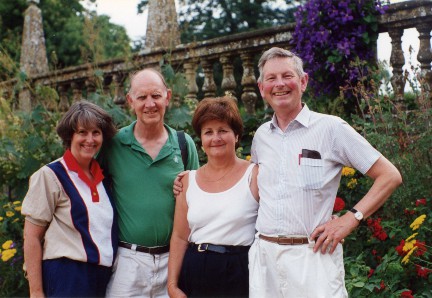
Oakes and Kimbers, 1994 Montacute House, UK
That evening we inquired of the proprietor where she would recommend eating. Her response was immediate: “Go up to the square and see if Jules is cooking tonight.” Further questions revealed that Jules, who owned Jules Restaurant, was unpredictable in preparing evening meals. We followed her advice and walked up to his place, knocked on the door and Jules opened it. We said we were looking for dinner and he had come highly recommended. He told us he was not cooking that evening, however he pointed across the street to a pub, The
Salutation Arms, and said, “Go there.” We looked dubious, however he assured us that we wouldn’t be disappointed. So we entered and were seated. The menu items as I recall had nice sounds to them. However, the time dragged on and our food did not come. Several times we gently prompted the waiter; each time she said, “You will not regret the wait.” This was an understatement. The food was superb, especially the desserts, each of which was individually prepared. Ann had sticky toffee and walnut pudding, with a spun sugar decoration on top. Mel had a brandy snap bowl with homemade cinnamon ice cream and butterscotch sauce. Don had an incredible bread and butter pudding with custard, while Pat had a strawberry mille-feuille layered with dark chocolate. Many of these items are still on their menu. Over the years we have often mused, “If this was the second best meal in Weobley, then what was Jules’ food like?!”
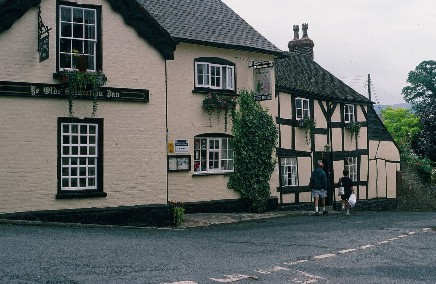
Ye Olde Salutation Inn, Weobley, UK
The next day we drove to Hay-on-Wye and visited the famous outdoor bookstores. Most were on the honor system, take your books and leave the money in a box. That evening we had dinner at our B&B in Crossgate. It was a three-course meal, smoked salmon, cod and haddock, wonderful vegetables and nutty crème pudding. After dinner, we chatted with a couple celebrating 61 years of marriage. Rev. Frederick J. Legge had risen from the coal mines in Wales to be an Anglican minister. He and his wife had adopted Jewish twins at the beginning of World War II who were escaping Hitler’s Germany. One had since died of a brain tumor and the other was a sister in a hospital. They told us many stories of their courtship and their life in the church. We were
trying to decide whether to go to church services at Westminster Abbey or St. Paul’s Cathedral. He scoffed at Westminster Abbey, you must go to St. Paul’s. He said if we were lucky we might hear Rev. Michael Saward. We followed his advice and sure enough Rev. Saward preached, afterwards we brought greetings to him from the Legges, he commented, “Is Fred still alive?” A little about the Legges. Fred was born in 1910 and died April 20, 2001 in Leicester, England. He and Audrey Compton Jenkins were married in Cardiff in 1933. Audrey was born in Cardiff in 1907, and died in Leicester in 2001. From the 1963 London Gazette, “The QUEEN has been pleased by Letters Patent under the Great Seal to present The Reverend Frederick John Legge to the Rectory of East Leake St. Mary the Virgin in the County of Nottingham, and Diocese of Southwell, void by the cession of the last Incumbent and in Her Majesty’s Gift for this turn only by reason of the avoidance of the See of CROWN OFFICE.”
Below are a few comments about Rev. Michael Saward, who was born in Blackheath, London, England, in 1932. After serving in the military, he returned to England from Ghana in 1952, Saward began studying theology at the University of Bristol. He graduated with a Bachelor of Arts (BA) degree in 1955. Having felt called to Holy Orders during his military service, he then studied for the priesthood at Tyndale Hall which was, at that time, affiliated with the University of Bristol. Saward was
ordained deacon in 1956 and priest in 1957 at Canterbury Cathedral. He wrote over 100 hymns; his best known is “Christ triumphant, ever reigning.”. He was Canon Treasurer of St Paul’s Cathedral in London until his retirement.—Mel
How would you describe your childhood bedroom?

As the eldest of four children—3 girls and a boy-all born within just a little over 5 years, bedroom space was at a
premium! In our house on Campina Court in Coral Gables, FL, Nancy and I shared a room and after Sandra, the youngest, was born, Dad designed and built a unique bedroom for our brother—it resembled a cabin in a ship. Dad was an engineer, and his dad had done a lot of woodworking, and Dad had learned a lot of valuable skills from him. It was built suspended from the ceiling of the garage and the bed was designed to go over the front end of the car and still allow us to have an enclosed garage space. There was a winding set of stairs (maybe 4 or 5 steps) which were accessible from the dining room. There were cabinets and cubby holes, and bookshelves —really fun. The last time I was in Miami, I visited our old house in Coral Gables—and, the bedroom was still there! When we moved to South Miami when I was about 13, I got a room of my own, Nancy
and Sandra shared a room and Robert had a room of his own. I remember that my room was blue and white and that the windows were jalousies, the type of windows popular at that time in Miami. I had a desk which had belonged to my dad, his bed—called a spool bed which my grandfather had built, a bookcase also made by my Grandfather Winter, and a comfortable chair which was covered in a blue and white print. The closet had sliding wood doors. The floor was terrazzo —we really liked them, as they were cool. We had no AC in the house, so if it was really warm, we would sit on the floor, which was cooler.— Pat
Our first house on South Washington Street was near a Catholic School and it had a playground. I have vague memories of playing there but none of inside the house. When I was about five, we moved to a newly built house in Kings, north of Vicksburg. I recall walking carefully on the floor joists before we moved in. There were only two bedrooms in the house, Mom and Dad in the front bedroom and the four boys in the back bedroom. There were two double beds, a tiny closet and one dresser. The only heat in the house was a kerosene heater in the master bedroom and what little heat the stove in the kitchen provided, which was a kerosene stove that produced almost no heat. Later, a large wood stove was purchased, which provided a warm kitchen. Everyone dressed in the kitchen during the winter. Our
brother, Charles, was nearly 10 years older than the rest of us and we greatly admired him. He often left in the morning before we could talk with him. I devised a scheme which I hoped would work. I arranged a thread that was attached to my toe and to the door knob with the hope that it would awaken me when he opened the door. Sadly, each morning, long after Charlie had left, I was disappointed by a broken thread.
It became clear as we were getting older that the bedroom was not working and our new sister, Eleanor, would need a bedroom. Also, my dad’s father, Charles Franklin Oakes, needed a place to stay. Behind the house was a laundry room and storeroom. It was decided to build four small bedrooms as a second floor. An elevated catwalk was added between the second floor and the main house. We each had a small room and Grandpa had one also. There was no plumbing and heat in the bedrooms were tiny gas space heaters, that provided so little heat that we only used them once or twice. The procedure during the winter was to gather your clothes and race in your underwear across the catwalk to the warm kitchen where Mom would have made a fire very early. We would dress for school by the fire. The main house had no toilet in the bathroom; an outhouse behind the laundry room was used. Needless to say, we developed strong bladders enabling us to sleep through the night, rather than make that long journey in the dark to the facility. Peeing off the catwalk
was frowned on with some success. There was a tub with cold water in the main house. To bathe, we carried heated pitchers of hot water from the kitchen to the tub. Since there was no heat in the bathroom, you didn’t loiter. Eventually we got a butane space heater for the dining room which was wonderful and opened up the house in the winter. Water came from the roof that was collected by gutters and channeled to an elevated water tank next to the house. The cold water was piped to the kitchen and the bathroom, no hot water heater. Annually one or two of the boys would be lowered into the tank to clean out the silt that accumulated. We would gag at the sight of mouse and bird skeletons in the silt. There was no filter on the tank! Apparently we developed immunity to the variety of bacteria that lived in that water. Much later dad added an outdoor shower on the junkyard which we and his employees used. In the summer the boys, after work, would walk a short way up Standard Hill where there was a waterfall with a small pool at the bottom. We would take clean clothes, towels and soap and bathe in the pool. This continued until we encountered a cottonmouth moccasin living in one of the openings we used to climb the waterfall and jump into the pool. Once we were in high school we had the luxury of hot showers in the boys’ locker room. Eventually, Dad added a toilet, however, it was always malfunctioning. —Mel
How has the country changed during your lifetime?

Without a doubt the largest change in my lifetime has been the introduction of Civil Rights Legislation which at long last
outlawed segregation and discrimination in housing, public accommodations, schools, employment and voting. While there remainss many injustices associated with each of these, the law at long last supports equity. As a child, I observed in Mississippi from my school bus, black children walking to school in sleet and heavy rain carrying textbooks that were the books previously used by white children but no longer in good condition. Another incident that I recall was an appearance in court by Dad who had bought something that turned out to be a stolen item. He was a witness. As we waited in the courtroom for his proceedings to begin, I watched a murder trial of a young black man. As I looked around the courtroom, I realized there was not another Black
person present in the room. It occurred to me, how frightening it must have been to look out on that crowd and not see one face that looked like him. How hopeless he must have felt. As so many during those times, it is highly possible that he could have been innocent.
Final Comment: I have never understood the failure of whites in the South to honor Martin Luther King. Without his nonviolent philosophy and leadership, there would have been so many deaths and so much destruction associated with the civil rights revolution. I guess I should not have been surprised as I have never seen a statue of Abraham Lincoln in the South, a man who saved the Union and freed an enslaved people.—Mel
The computer and the iPhone created a true world revolution in my lifetime. The iPhone linked people together across the world and provided valuable information on any topic at one’s fingertips. In a more personal way, it was the introduction of the Macintosh computer that altered many aspects of my life. Apple in 1984 offered UT faculty and staff a discount on their new computer. This was done to break the monopoly that the PC had at that time.
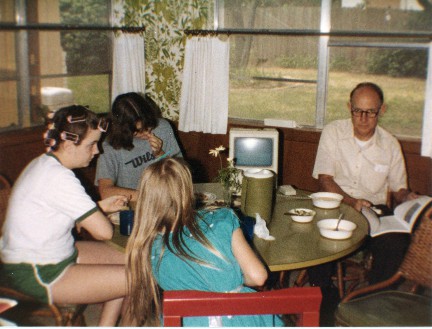
Beth, Sarah, Mardie, Mel and new Macintosh 1984
Mel brought ours home and the first night, Beth wrote a research paper for school. It was stressful and was not completed until 2 am in the morning, however it was my first personal experience with a computer and I soon embraced it and utilized it in many activities both professionally and privately.—Pat
What sports did you like most when you were young?

When I was nine years old (1945), my mother bought us a softball. That evening when Dad came home from work, he took
the softball away and the next day after work he returned with a regulation baseball, bat and gloves. Soon after he put together a baseball team from neighborhood and school kids. He provided uniforms, catcher’s equipment, bats, balls, coaching and transportation. The charter members of the team ranged in ages between 10 and 14. The team consisted of students from Redwood School, mostly living in Waltersville, Kings and the barrel mill housing. The mill consisted of the Head, Hoop, and Stave Mills between Kings and Redwood, near Chickasaw Bayou. Brothers, Floyd and Donald, were members of the team as well as Norman Oakes—our cousin.
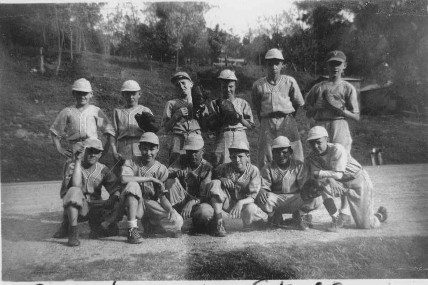
Back: Donald Oakes, Phares Griffin, Billy Wayne Bishop, Mel Oakes, Norman Oakes, Billy Wright; front—Floyd Oakes, Bobby Jernigan, Harold Barker, Lamar Thomas, Earl Martin, Johnny Griffin
On Sunday afternoons we played teams from Vicksburg neighborhoods and from small communities in the Mississippi Delta. Transportation was the back of Dad’s pickup truck. A ritual after the game was to stop at a general store or gas station where Dad would buy everyone a “soft drink.” No alcohol, smoking or foul language was permitted around the game. For many of the kids, this was their only activity since their parents were busy making a living and had little time to spend with their children. Because of baseball, we got to develop friendships with boys in
Vicksburg which we enjoyed. One team had a girl third basewoman who was an excellent player. Her name was Jean Meade, she went on to excel in women’s sports. I recall seeing her hit a home run out of the park at the YMCA field. I loved baseball. In the beginning, I played first base but soon shifted to third base since I had a strong arm. Despite our young age, we often played teams with adult players. The games were often in small communities and there would be a picnic before the game, and included many people from the area who came to watch us play. Most of us went on to play basketball and by eighth grade we were also involved with football. The team played every summer until I graduated from high school. Baseball remained my favorite sport though we had a very successful high school basketball team that was undefeated (29-0). From time to time, Floyd and I would also play with the American Legion Team or semi-pro teams in the area. I later played basketball and baseball at Hinds Junior College.
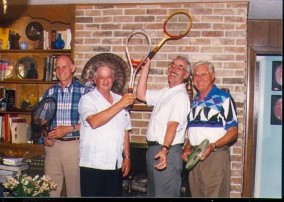
Mel Oakes, John Towery, Garry Cole and Gordon Flack, original tennis group.
At about age 30 I took up tennis at the suggestion of Donna Jobe, a neighbor, when I complained about the boredom of jogging. I loved the sport and continue to play as of this writing. While I no longer watch major league baseball regularly, I still get caught up in the excitement around the World Series and watch most of the games.
Who was your favorite school teacher? Why?

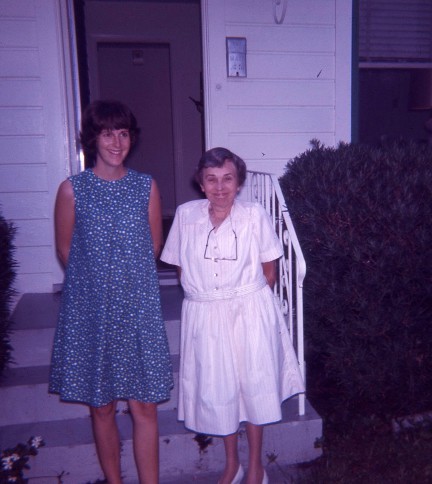
Aug. 1967 Pat (pregnant with Beth) with her beloved 6th grade teacher, Miss Nina Drew
I was blessed with many good teachers during my early education. My all-time favorite was my 6th grade teacher, Miss Nina Drew, who taught at the Merrick Demonstration School, grades 1-6, a lab school created by the University of Miami to
provide teaching/training opportunities for college students studying elementary education. It was not a public school, but no tuition was charged. Parents of potential students had to apply when their children were very young. Efforts were made to ensure that there were students of many different abilities within classes. In that period of time, all of the students and teachers were white. Classes were no larger than twenty-five students. We went to school four and a half days per week which allowed the potential student teachers to come and observe classes on Saturdays. Miss Drew was a very special person—she was smart, organized, caring, and had a great sense of humor. She was very hunchbacked which made her quite short compared to other adults, and she was a terrible speller. I marvel that she was so intrepid that she had no concern about getting up in front of a classroom every day! She cheerfully gave extra credit to students who caught her with a spelling error. That, of course, made a big difference in whether or not we were paying attention. We loved getting extra credit. She encouraged all of us to work hard. I stayed in touch with her for many years. She taught all four of us—and she was planning on coming to a family reunion years later, but sadly she died during a surgery shortly before the reunion. I like to think that she inspired me to be a better teacher when I was an adult. —Pat
While in high school, I pursued sports, girls, and math and avoided the only science course offered in the school. I was, however, hounded by one teacher, who was determined that the tradition in the community of not attending college would not extend to me and several of my classmates. Our English teacher, Maude Franklin, relentlessly—with little thanks at the time—surrounded us with grammar, wonderful prose, poetry, plays, and, despite my wife’s contention to the contrary—spelling. I can still recite poetry that she required us to memorize. Her encouragement was pivotal in my decision to continue school following graduation.
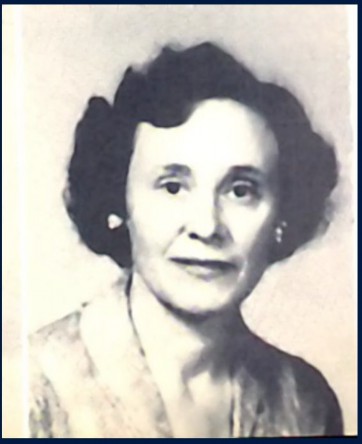
Willie Maude Mize Franklin
Armed with this arsenal and some basic mathematics, I attended Hinds Junior College in Raymond, MS, to play basketball and baseball and to prepare for a career as a coach. There I encountered another teacher who was not to be denied. Lurline Stewart taught mathematics, and it was her life. She instructed all students, however, she reserved her heavy artillery for those she believed might “deserve” a career in math or science.
Recognizing the meager background of most of her students, she spent many extra hours each week filling in the holes and bridging the gaps. One day after class she stopped me and asked, “What are you going to do with your life?” I said, “I plan to be a coach like my high school coach, whom I greatly admire.” Her response, “No way you are going to be a coach. You need to do something that involves mathematics. If you wanted to study at LSU, I could get you a scholarship that would entitle you to in-state tuition. And she did. It was in her class that I learned the importance of classroom participation. We had to enter her classes prepared to participate; sleep was not an option. Never a day passed that I didn’t learn something. Admittedly, we only had about 35 or so students in the class, so it was quite easy for her to include all of us. The results of her dedication were that we made up the lost time and were quite ready to see what a university would have to offer. Between the math courses and a physics course, it was clear to me that I wished to be a physicist.—Mel
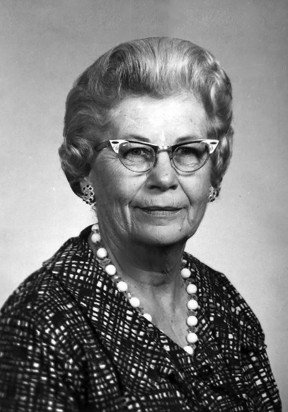
Lurline Stewart
Describe any memorable school trips.

When I was in maybe ninth grade, Mr. Ralph Wells taught a shop class. One day he took us to his farm and said we were
going to dress a pig. We were confronted with a very large live pig which he proceeded to shoot in the head. We next filled a large cauldron with water and built a fire under it and boiled the water. Once it was boiling we heaved the pig in the cauldron. After some time we removed it and all were given scrapers to remove the hair from the pig. The now naked pig’s entrails were removed and we were shown how to cut it into various cuts of meat. This was a first experience for many of us. Sometime later we returned to his farm where the class was to assist in the castration of several pigs. It was almost as painful for the teenage boys as for the pig. At the end of the semester there was a question on the final, “What is the scrotum?” Bob Hollowell, who passed away in 2025, wrote, “It is a bag that a pig keeps his utensils in.” We never let Bob forget that. —Mel
How would you describe the neighborhood where you grew up?

While Mel was growing up in rural Mississippi, I was growing up in a new suburb of Miami, Coral Gables. Mom and Dad had
bought a new home on Campina Court. By this time World War II was almost over. As our family grew from 3 to 6 folks (our parents, myself, Nancy, Bobby, and Sandy). Dad made some additions—a Florida room at the back, a master bedroom and another bath, enclosed the front porch and built a suspended bedroom which cleverly fitted over the car while it was in the garage. Dad was constantly adding improvements to wherever we lived. We had wonderful neighbors who lived next door, with two children near our ages, and we all loved playing together. We loved roller skating on the sidewalk, playing jacks and riding our bicycles around the neighborhood. Mom made sure we were enrolled at nearby Merrick Demonstration School —an excellent
lab school associated with the University of Miami that was free to those kids who were admitted into the school. We lived on Campina Court until we moved to South Miami about 1953 to a larger home where there was also room to add on. Dad, with the help of some neighbors, built a swimming pool taking advantage of using the native coral rock which served as the floor and two walls (they were plastered over). It was great fun to see the ditch digging machine come and scoop out the huge chunks of rock. The pool soon became a neighborhood hangout. Mom used a flag to show when the pool was open to the kids. It was a primarily Catholic neighborhood—7 kids behind us, 5 next door, 4 across the street. A new Catholic school had opened nearby. Nancy and I soon had pretty well covered the babysitting market. A lot of folks in the ‘hood’ worked for Pan Am so there was soon a Pan Am carpool. Folks soon seemed like family to all of us.—Pat
At the age of five, we moved from South Washington Street in Vicksburg, MS to a small community called Kings just north of town. It was not incorporated and had no civil structure other than a justice of the peace. It was in Warren County. My dad had purchased the land earlier in order to house wrecked or old cars which he took parts from to repair cars and trucks at his Mulberry Street shop in Vicksburg. He finally decided to build a house on that property. I think the carpenter was a Mr. Ashley. I remember walking on some of the floor joists during
construction. The house had only two bedrooms and a living room, with French doors opening into the dining room. There was a kitchen and one bathroom between the two bedrooms. This was a very small house for a family of four, soon to be five. There was no indoor bathroom plumbing. An outhouse was behind the house. There was a tub in the bathroom, but no hot water. Mother heated water on the kerosene stove and carried it to the tub. The tub drained onto the ground under the house, which was pier and beam. Water came from a rain gutter fed storage tank on an elevated stand adjacent to the house.
The neighborhood was largely made up of Black families. Neighbors to the north, east, and west were Black. Neighbors to the south were the Hallbergs. Mr. Hallberg worked in town and Mrs. Hallberg ran a small grocery store, and the family lived in the back. They had three children, Charles, Lilly Sue, and Loney Joe. They were our first playmates. Many Black families lived between us and our other regular playmates, Barbara and Bill McDuff. They lost their mother and their father gave them to their Grandmother Roberts to raise. They lived in a large two-story house with many nice architectural features. Mrs. Roberts owned a lot of the surrounding property that she earned rental income from, including a grocery store run by Abraham George.
Growing up in this neighborhood, we often played with Black children. Mother employed Black maids for housework,
especially ironing, though eventually we learned to iron. Dad’s business, which eventually moved completely to Kings, consisted of many Black customers and workers. A few miles north was a barrel mill, which employed many of our playmates’ parents. It was only a bicycle ride away. There were always kids from the neighborhood at our house.
There was another grocery store that was maybe a quarter of a mile or less away that we frequented. It was run by Mr. and Mrs. Cain. The nicest house and yard in the neighborhood was owned by a Black woman who was a Seventh-day Adventist like my mother. Across from the house was a water well which many in the neighborhood used as a source of drinking water. Farther away was Spouts Spring, a water pipe that tapped into a spring in the hillside. We were told that it dated back to the Confederacy days. The water was always cool and used by many. It was said that General Ulysses S. Grant and his soldiers watered their horses there. There was a nearby waterfall that we often bathed in, after working in Dad’s yard.
We felt safe in the neighborhood, most of the Black community did business with Dad and were on good terms with him. We often heard, “You one of Mister Oakes’ boys?” However, the economic condition of Black families was quite bad. I recall visiting in homes and seeing the funnies (comics) from the Sunday paper used as wallpaper because of the bright colors.
Highway 61 ran in front of our house. I have memories of the trucks carrying Black hoe-hands or cotton-pickers at 5 am to the fields in the Delta; they would return between 6 and 7 pm. At the time, the pay was $3.00 a day. It was hard work in the hot sun. Many of the workers were women and children.—Mel
What book has made a significant difference in your life?

This will be a strange answer in some ways. First, I would mention “Only in America” by Harry Golden. Golden published
the “Carolina Israelite”, a newspaper in Charlotte, NC. In his book, Golden pointed out the glaring inconsistencies in racial segregation across the nation. An example, a black woman could attend segregated events if she was there in her role as nanny to a White child. Golden’s suggestion was to have Black people carry White dolls. Another example pointed to the practice of blacks in servant roles could accompany Whites in forbidden places. Golden suggested Blacks could attend White schools if they would simply carry the books of the White children. This book resonated with me at a time that civil rights demonstrations were occurring across the South.
My other book was “Waves” by Professor Fred Crawford. It was one of the five Berkeley Physics Series. It was a very different way of presenting physics, in this case, waves and optics. It introduced advanced topics in a manner understandable to undergraduate physics students. Crawford’s love of physics and his ability to analyze phenomena and extract the essential factors was exceptional and transformed my thinking about teaching physics. I used the book in my sophomore physics class and over the many ensuing years, I have very often heard back from students who point to the transformative effect it had on them and their careers as physicist. Long after retiring, I will open the book and reread some section that I found insightful.—Mel
A Life-Changing Event

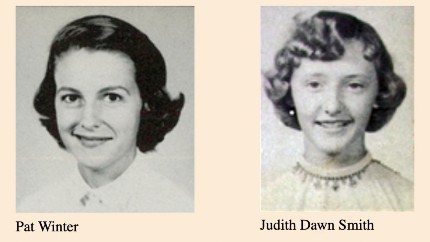
Pat Winter and Judith Dawn Smith
On April 1, 1958, Pat Winter (Oakes), Coral Gables, FL, and Judith Dawn Smith (Greavu), Holly Hills, FL, received letters from Rev. Maldwyn V. Parry “Uncle Mo”, Advisor to Florida Pilgrim Fellowship, Avon Park, Florida, (Sponsored by the Florida Conference of Congregational Christian Churches) notifying them that he, Miss Dorothy Hampton, North Carolina, and Miss
Annie Campbell, Atlanta, GA, while at a National Meeting discussed having representatives from their church conferences at the first United Senior High Conference at Bricks, June 8-14, 1958. They discovered that the National Office of Social Action would also provide scholarships to aid two delegates from Southern and Florida Conferences. Since Pat and Judy had been alternate delegates to the National Migrant Youth Camp, it was decided to recommend them as the representatives. The scholarship would cover travel from Orlando to the conference and back, meals en route, $5.00 toward the $15.00 registration fee. The conference, which included 39 total participants, was to be held at The Franklinton Center at Bricks in Whitakers, North Carolina, which has a rich history rooted in both the painful legacy of slavery and the pursuit of education and empowerment for African Americans. Initially a slave plantation, it transformed into a center for learning, first as the Joseph Keasbey Brick Agricultural, Industrial, and Normal School (1895) and later as the Franklinton Center. The Franklinton Center was formed to provide opportunities for Christian education, fellowship, and recreation.
Since Dorothy Hampton’s bus travel arrangements ended in Raleigh, she arranged for Pat and Judy to stay overnight in Raleigh with a family that was bringing their daughter to Bricks, however, characteristic of Pat’s dad, Robert Winter, he worked
his magic and arranged elaborate bus reservations that would take them all the way to Bricks, hence they declined Miss Hampton’s offer. Pat and Judy were to return a day early in order to make a report on their trip to the Senior High Conference in Avon Park.
In all of the correspondence related to the conference, there was no mention that it was to be interracial, likely done for security reasons. A search of newspaper databases yields no articles related to the conference; however, All-Black conferences and meetings there are well covered.
Pat tells the following story: On the last leg of the bus trip, a Black girl got on the bus. She told the driver that she was going to Bricks. Pat’s assumption was that she was likely part of the kitchen staff. Upon arrival she learned that the girl was her roommate. Pat, at that moment, recognized her racism, something she had been unaware of in her largely White Miami community.
Judith Smith Greavu, who became a successful sculptor who taught at Ohio Northern University, recalls, “I do remember the visit to the tenant farmer camp and my social conscience was forever changed by those experiences and the Union Congregational awareness of another way to approach race relations beyond what was encouraged by most of the Florida
population and even preached by many of the churches.”
There were a number of field trips during the conference. One trip was to study tenant farm conditions. On these trips, Pat reported that they were accompanied by men riding shotgun, LITERALLY! I certainly had never seen people carrying guns in cars. We soon realized that was because they were protecting us. That experience made me so aware of the deep racial divide in our country and made me want to work to bring that attitude to an end.—Pat
Travels with Don and Ann Kimber

Little did I realize that when I was a college freshman at FSU in Tallahassee and showed up at the Sunday evening
Congregational Church Group at the Baptist Student Union that I would not only meet the man I would marry, but would also meet a graduate student in geography from Bristol, England, Don Kimber, who became a lifelong friend. Mel, not a churchgoer, had come with his good friend Dick Berkley so Mel could meet the cute blonde president of the group whom I was not. I still remember what I was wearing—a pleated plaid wool skirt, a white angora sweater, wool socks and black penny loafers. I was immediately smitten with Mel and his beautiful blue eyes—but I digress.
Between that late October and coming back to school after Christmas break (I had had my braces removed during the break), we started meeting up occasionally at Don’s office where
he would serve afternoon tea, sing, and play his guitar. I can’t remember when Don went home—maybe that spring or the next year. By that time we all had become good friends and stayed in touch.
When Don got back to England, he met and fell in love with Ann. When Mel and I were courting, we talked often about where we would like to travel—and we thought we would certainly go to England sometime. We married in 1963 and started saving our money, and in 1966 we flew on a UT charter flight to London. After a few days in London, we took the ferry to France. We picked up our 1966 green VW “bug” in Paris, drove about four thousand miles throughout Europe, and then took a ferry across the channel to England. We finally found Don and met Ann and their infant son Paul and started a life-long friendship which continues to this day.
The four of us are older now and international travel is no longer an option—but what fun we have had. By my count, we have made six trips “across the pond” spending weeks of time with the Kimbers. We even took our 3 daughters with us one time—in 1984. Beth was entering her senior year, Sarah was going into 10th grade and Mardie was going into 6th grade. Sarah was not at all enthused about the trip-she wanted to spend her summer at Barton Springs Pool. We told her that she could not stay here, but that she could go spend the several weeks with her
grandparents in North Carolina. Reluctantly, she agreed to go to Europe with us. When asked after several days into the adventure (lots of museums, palaces, parks, etc., in London) what she thought about the trip so far, she replied, “It sort of seems like one long school field trip!!” We rented a car and we four kept reminding Mel who was driving to “Keep Left!!!”
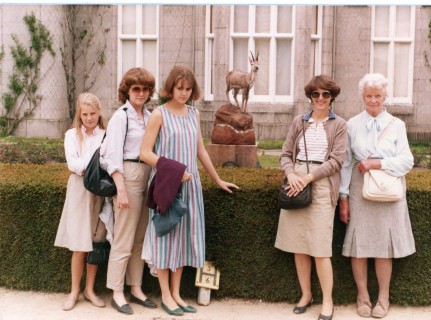
Mardie, Beth, Sarah, Pat and Mardie Winter, Perth, Scotland
We saw many sights before we got to the Kimbers—Burnham-on-Crouch, Cambridge, York, Castle Howard, Edinburgh and finally to Perth to see our last remaining cousin in Scotland, Big Mardie (for whom our Mardie is named),
Scone Palace where our great-great-great-grandfather Patrick Murray Winter worked as a gardener, going back south to the Lake District, Oxford and more. It was funny as we told the kids about each new site we were going to see, they expressed their lack of interest and when we left they complained that we were leaving too soon.
We finally made it to Bristol and introduced the girls to Don and Ann and their two sons—Paul, 16, and Phil, 14. We visited Avebury (Europe’s largest neolithic stone circle) the next day—all 9 of us—in two cars. We also enjoyed a marvelous cream tea—pure bliss. We had 2 more wonderful days with the Kimbers.
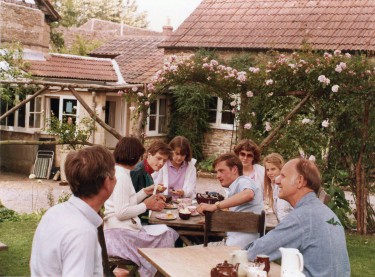
Lunch with Kimbers at Lacock Abbey.
Don, Ann, Phillip, Sarah, Paul, Beth, Mardie and Mel
When it was time for us to leave, we nearly had a rebellion—the girls loved being there. As we found in our other travels throughout England with Don and Ann, there were never any cross words. They introduced us to so many wonderful sites and people. Another really high point of our trip was a last-minute decision to go to opening day at Wimbledon. We then continued our trip to Lausanne, Switzerland, where Mel was attending a plasma physics conference—Pat
What are some memories of your mother?

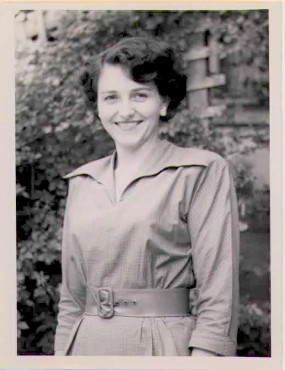
Lois Lincoln Brown Winter
Lois Lincoln Brown was born August 23, 1919 in Bryantville, MA, to Harold Foster and Ruby Emeline Benson Brown. She was one of six children, four girls and two boys. Lois graduated from high school in Wrentham, MA. Her father and mother divorced, and Ruby became the sole provider for the family. Mom had many chores to help provide income for the family, peeling gladiola bulbs for sale was one she mentioned. This experience made her a thrifty woman for the remainder of her life. She made clothes for the family, made hundreds of pounds of fruit cake to provide Christmas for the family and took a job at Gables High School to provide some extra income. Mom was active in PTA and served as president of the Pan American Engineers’ Wives Club. She was supportive of all of us getting a college education. In her job as attendance monitor at Gables, she encountered students neglected by parents. Several of these she and dad took into our household until better supervision could be found. One of these, Jean Davis, remained with the family through graduation. Mom and Dad were active in Plymouth Congregational Church. She and Dad took up square dancing and appeared on Ted Mack’s Amateur Hour. Despite all of her many accomplishments, she never fully appreciated what an amazing woman and mother she was.—Pat
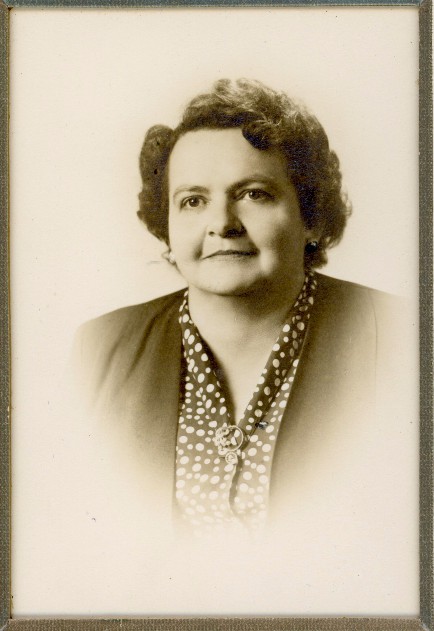
Margie Louise Hartley Oakes
Margie Louise Hartley was born in Flora, MS, in 1906 to George Leroy and Mary Elizabeth Varner Hartley. She was one of nine children, five boys and four girls. Margie was an excellent student in school. She won a number of school literary and history competitions while in high school. Despite being a good student, she did not finish school, choosing instead to marry my father two days before her seventeenth birthday. He was twenty at that time. My memories of my mother center around her love of music and writing. I do not know where she learned to play the piano. She read music really well. Our piano bench was always filled with sheet music, nearly all were popular songs, old and new, and some hymns. When guests would come to the house they would urge her to play, which she usually did. She occasionally would fill in for an absent pianist at the Seventh-Day Adventist Church that she attended. I don’t recall any of her siblings playing the piano. She had me take piano lessons, which I sadly did not continue, however my sister, Eleanor, did and played for the schools where she taught and at the churches she attended. The other passion my mother had was letter writing. She had an extensive correspondence with family and friends. This contrasted starkly with my father, whose letters were very few and far between. Mother often wrote letters to the local newspaper, especially related to some historical article that appeared in the Vicksburg paper. After
mother died and I commenced doing genealogy, I discovered many relatives, unknown to me, that she corresponded with about family news. She had a beautiful penmanship, flowing cursive and easily readable.
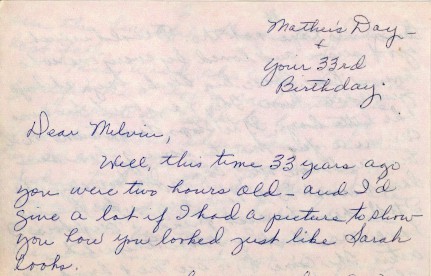
Letter from Margie Oakes to Melvin, 1969
She read regularly the newspaper, magazines and church literature. I attribute my joy of reading to her. Mother was also an outstanding cook. Her biscuits, chili, and turkey stuffing were unparalleled in my opinion as well as that of many neighborhood friends and relatives. She was very active in the PTA at Redwood, serving as president several times. She was loved by neighborhood and school kids, especially for the birthday parties and for meals before and after ballgames. She was a leader in her
church. Sadly, Mom died at the age of 63, however she lived to see our second daughter, Sarah Hartley Oakes, born and was deeply moved by the inclusion of Hartley in her name. I so wished she could have lived longer to see the accomplishments of her many grandchildren.-Mel